How to Make a Monthly Budget: A Complete Step-by-Step Guide
Learn how to create a realistic monthly budget from the ground up, organize your income and expenses, plan for savings and debt, handle irregular expenses, and build a budgeting system you can actually maintain.

- What Is a Monthly Budget?
- Why Is Budgeting Important?
- Determine Your Monthly Income
- List Your Monthly Expenses
- Separate Needs From Wants
- Fixed vs. Variable Expenses
- Calculate Your Monthly Cash Flow
- Create Savings Categories
- Include Debt Payments
- Choose a Budgeting Method
- Build Your First Monthly Budget
- Example Monthly Budget
- What If Expenses Are Higher Than Income?
- Budgeting With Irregular Income
- Handling Irregular Expenses
- Common Budgeting Mistakes
- How to Stick to Your Budget
- How Often Should You Review Your Budget?
- Frequently Asked Questions
What Is a Monthly Budget?
A monthly budget is a plan for how you intend to use your money during a particular month. It starts with the money you expect to receive and then assigns that money to different purposes, such as housing, food, transportation, utilities, debt payments, savings, investing and personal spending.
A budget can be as simple as a handwritten list or as detailed as a spreadsheet containing dozens of categories. The important part is not the tool you use. The important part is that the plan gives you a realistic picture of where your money is expected to go.
At its simplest, a monthly budget should answer several important questions:
- How much money do I expect to receive this month?
- What expenses must I pay?
- What expenses can I control or adjust?
- How much can I save or put toward financial goals?
- How much money should remain available for unexpected expenses?
A budget is therefore more than a list of expenses. It is a plan for directing your available money before it disappears through everyday spending.
A useful budget should reflect your real financial life, not an imaginary version of how you think you should spend.
Why Is Budgeting Important?
Without a budget, it can be difficult to see how individual spending decisions affect your overall finances. A small purchase may seem harmless on its own, but dozens of small purchases can become a meaningful part of your monthly spending.
Budgeting gives you a broader view. Instead of considering each transaction separately, you can look at your income, essential expenses, savings goals, debt payments and discretionary spending together.
A budget can help you:
- Understand where your money is going.
- Prepare for regular and irregular expenses.
- Identify spending that may be unnecessary.
- Plan for savings and financial goals.
- Manage debt payments.
- Reduce the likelihood of spending more than you earn.
- Make financial decisions with more information.
Budgeting is not simply about spending less. It is about making deliberate decisions about where your money should go.
Step 1: Determine Your Monthly Income
Before creating your expense plan, determine how much money you realistically expect to have available during the month.
If you receive a regular salary, this may be relatively simple. You can generally start with the amount you expect to receive after deductions.
Income can also come from freelancing, commissions, business activities, contract work, rental income, seasonal work or other sources.
If your income changes substantially from month to month, avoid building essential expenses around your highest-income month. Using a conservative estimate can give you more room to deal with months when income is lower.
Use income you can reasonably expect
One common budgeting mistake is counting money before it actually arrives. If a bonus, commission or other payment is uncertain, consider treating it as additional income rather than money required for essential expenses.
When additional income does arrive, you can decide whether to direct it toward savings, debt, investing, business expenses or another financial goal.
Step 2: List Your Monthly Expenses
Once you understand your expected income, create a complete list of the expenses you expect to have during the month.
Housing
- Rent
- Mortgage payments
- Property-related costs
- Maintenance
Utilities and Communications
- Electricity
- Water
- Gas
- Internet
- Mobile phone
Food
- Groceries
- Restaurants
- Takeaway
- Work meals
Transportation
- Fuel
- Public transportation
- Vehicle payments
- Maintenance
- Parking
- Insurance
Financial Obligations
- Credit card payments
- Personal loans
- Student loans
- Other debt
Personal and Lifestyle Spending
- Clothing
- Entertainment
- Hobbies
- Subscriptions
- Personal care
Step 3: Separate Needs From Wants
Separating needs from wants can help you understand which expenses are essential and which have more flexibility.
A need is generally an expense required for basic living, safety, work or an important financial obligation. Examples can include basic housing, essential food, necessary transportation, required insurance and minimum debt payments.
Wants are expenses that provide comfort, convenience or enjoyment but are not essential to meeting basic needs. Examples can include entertainment, restaurant meals, premium subscriptions, luxury purchases and certain hobbies.
The distinction is not always absolute. Internet service, for example, may be optional for one person but essential for another person who works online.
Step 4: Identify Fixed and Variable Expenses
Another useful way to organize expenses is to separate them into fixed and variable categories.
Fixed Expenses
Fixed expenses generally remain relatively stable from month to month. Examples include rent, mortgage payments, loan payments and certain insurance premiums.
Variable Expenses
Variable expenses can change depending on your behavior or circumstances. Examples include groceries, fuel, entertainment, clothing and restaurant spending.
This distinction becomes particularly useful when you need to reduce expenses. You may have little immediate control over rent, but you may have more flexibility over restaurant spending or entertainment.
Step 5: Calculate Your Monthly Cash Flow
Now compare your expected income with your planned expenses.
For example, suppose your monthly take-home income is $3,000 and your planned allocations total $2,800. That leaves $200 that can be assigned to another goal, kept as additional savings or used as a financial buffer.
If your planned expenses are greater than your income, the budget has identified a problem before the month is over.
Income − planned spending − savings and financial allocations = your remaining available money.
Step 6: Create Savings Categories
Saving can be more effective when it is included directly in your monthly plan instead of being treated as whatever happens to be left over.
Emergency Savings
Emergency savings are intended to provide a financial buffer for unexpected expenses or disruptions.
Short-Term Goals
These might include a holiday, education expenses, a new computer, furniture, repairs or another planned purchase.
Long-Term Goals
Long-term goals can include retirement, education, home ownership or other major financial objectives.
Giving each goal a name and target amount can make saving easier to measure and monitor.
Step 7: Include Debt Payments
Debt should have a clear place in your monthly budget. Start by including required payments so that important obligations are not overlooked.
Once essential expenses and required payments are accounted for, additional money may be directed toward debt depending on your financial circumstances.
Debt Snowball
The debt snowball method generally prioritizes the smallest outstanding balance while maintaining required payments on other debts.
Debt Avalanche
The debt avalanche method generally prioritizes the debt with the highest interest rate first.
Both approaches have different advantages. The appropriate choice depends on your debts, interest rates, income and personal circumstances.
Step 8: Choose a Budgeting Method
There is no single budgeting system that works for everyone. Choose a method that you understand and are likely to maintain.
50/30/20 Budgeting
The commonly known 50/30/20 framework divides after-tax income approximately between needs, wants and savings or debt repayment.
It is a guideline rather than a universal rule. Housing costs, income levels, family responsibilities and local living costs can make those percentages unsuitable for some households.
Zero-Based Budgeting
A zero-based budget assigns every unit of available income to a specific purpose. Savings and debt payments are included as allocations.
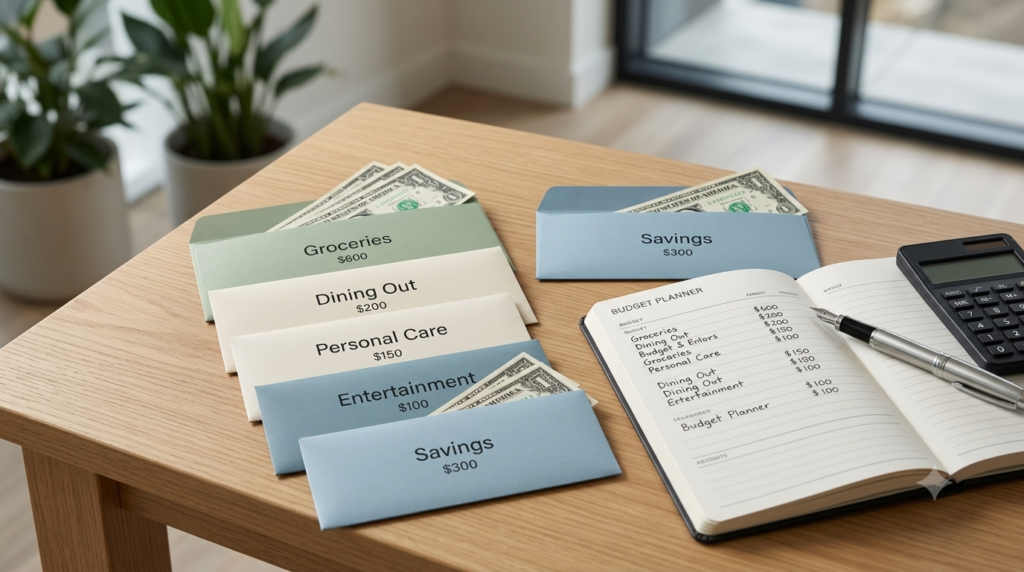
Envelope Budgeting
Envelope budgeting assigns spending limits to specific categories. The system can be used with physical cash or adapted to digital accounts and budgeting tools.
Pay-Yourself-First Budgeting
This approach prioritizes savings or investing before discretionary spending. A predetermined amount is allocated toward a financial goal when income arrives.
Step 9: Build Your First Monthly Budget
Now combine your income, expenses, debt payments, savings and financial goals into one plan.
The goal is not to create perfect numbers immediately. Your first budget is also an opportunity to learn how your actual spending compares with your expectations.
Start with the expenses that are easiest to identify. Then add flexible spending, savings, debt payments and less frequent expenses.
Example Monthly Budget
Consider a person with $3,000 in monthly take-home income. The following is an illustration of how that money could be allocated.
| Category | Planned Amount |
|---|---|
| Housing | $900 |
| Groceries | $350 |
| Transportation | $250 |
| Utilities | $200 |
| Insurance | $150 |
| Debt payments | $300 |
| Personal spending | $150 |
| Entertainment | $100 |
| Emergency savings | $300 |
| Long-term savings | $200 |
| Miscellaneous | $100 |
| Total | $3,000 |
This is an illustration rather than a recommended allocation for everyone. Your actual budget should reflect your own income, expenses, location, obligations and financial goals.
What If Your Expenses Are Higher Than Your Income?
A budget can reveal a deficit before it becomes a bigger problem.
Suppose your income is $2,000 but your planned expenses total $2,300. You have a $300 gap.
Begin by examining flexible expenses, but do not assume that small cuts will solve a large structural problem.
Depending on your circumstances, you may need to consider larger changes involving housing, transportation, debt obligations or income.
You can also look for opportunities to increase income, reduce recurring costs or redirect money from lower-priority goals.
How to Budget With Irregular Income
Budgeting can be more challenging when income changes substantially from month to month.
This is common among freelancers, contractors, business owners, commission-based workers and seasonal workers.
One approach is to build essential expenses around a conservative income estimate rather than your best month.
When income exceeds that estimate, additional money can be directed toward savings, taxes, debt, business expenses or other goals.
How to Handle Irregular Expenses
Some expenses do not arrive every month, but they can still be predictable.
Examples include annual insurance payments, vehicle maintenance, school expenses, holidays, property-related costs and annual subscriptions.
If you expect a $600 annual expense, setting aside approximately $50 per month can make that future payment easier to handle.
This type of planned saving is often referred to as a sinking fund.
Common Budgeting Mistakes
Creating an Unrealistic Budget
A budget that assumes you can cut a normal $300 food bill to $50 without changing your circumstances is unlikely to be sustainable.
Forgetting Irregular Expenses
Annual and seasonal expenses should be considered before they become urgent.
Ignoring Small Purchases
Small recurring expenses can accumulate. Tracking your spending for a month can reveal patterns that are difficult to see otherwise.
Treating Savings as an Afterthought
If saving is an important financial goal, include it directly in the monthly plan.
Making the Budget Too Complicated
A system that takes hours to maintain every week may become difficult to sustain. Start with the categories that matter most.
Giving Up After One Bad Month
Unexpected expenses happen. A budget is a planning tool, not a pass-or-fail examination.
How to Stick to Your Budget
Creating a budget is only the beginning. The real value comes from consistently using and adjusting it.
Check Your Spending Regularly
A quick review once or twice a week can help you identify problems before the end of the month.
Automate Where Appropriate
Automatic transfers can help with recurring savings goals and scheduled financial obligations.
Give Yourself Discretionary Money
A realistic budget should allow some room for enjoyment where your financial circumstances permit it.
Review Recurring Expenses
Subscriptions and automatic payments can continue for months or years without receiving much attention. Review them periodically.
Keep a Buffer
A small flexible amount can help absorb minor unexpected costs without forcing you to rebuild the entire budget.
How Often Should You Review Your Budget?
A practical budgeting routine can have three stages.
Before the Month
Create or update the plan based on expected income, bills, savings goals and upcoming expenses.
During the Month
Check actual spending against your planned categories.
At the End of the Month
Compare what you planned with what actually happened.
Ask yourself:
- Where did I spend more than expected?
- Where did I spend less?
- Did an unexpected expense appear?
- Did I save what I planned?
- Did my income change?
- What should I change next month?
Frequently Asked Questions
Is budgeting only for people with low incomes?
No. People at many income levels can benefit from budgeting. A higher income does not automatically prevent overspending.
Should I save before paying debt?
The appropriate balance depends on your circumstances, including your debt costs, emergency savings, income stability and other financial obligations.
How much should I spend on housing?
There is no single percentage that works for everyone. Housing affordability depends on income, household circumstances, transportation, taxes, debt and other expenses.
What if I cannot save money?
First determine why. If essential expenses consume most of your income, the solution may require larger changes to expenses, income or debt rather than simply cutting small purchases.
Should I use an app or spreadsheet?
Either can work. A spreadsheet, notebook, budgeting application or simple document can all be useful. The most important factor is using a system consistently.
Can I change my budget during the month?
Yes. A budget is a plan and can be adjusted when circumstances change or unexpected expenses occur.
Final Thoughts
A monthly budget does not have to be complicated. Start by understanding how much money comes in, where it needs to go, what you want your money to accomplish and what changes may be necessary to keep spending within your available resources. Review the plan regularly and allow it to change as your financial circumstances change.
Provenzy provides general financial education and information. Financial products, rates, fees, laws, tax rules and consumer protections vary by country and individual circumstances. Content on this website is not personalized financial, legal, tax or investment advice.