Zero-Based Budgeting Explained: How It Works, How to Create One, and Whether It’s Right for You
Zero-based budgeting is a detailed budgeting method that gives every unit of your income a planned purpose. Learn how zero-based budgeting works, how to create a zero-based budget step by step, how to budget for savings and debt, common mistakes to avoid, and whether this budgeting strategy can help you take better control of your money.

- What Is Zero-Based Budgeting?
- How Does Zero-Based Budgeting Work?
- Why Use a Zero-Based Budget?
- Does Zero-Based Mean Having Zero Money?
- How to Create a Zero-Based Budget
- Calculate Your Monthly Income
- List Your Monthly Expenses
- Plan for Irregular Expenses
- Include Savings Goals
- Include Debt Payments
- Give Every Dollar a Job
- Zero-Based Budget Example
- Advantages of Zero-Based Budgeting
- Disadvantages of Zero-Based Budgeting
- Zero-Based Budgeting vs Other Methods
- Zero-Based Budgeting With Irregular Income
- Common Zero-Based Budgeting Mistakes
- How to Stick With a Zero-Based Budget
- Who Should Use Zero-Based Budgeting?
- Frequently Asked Questions
What Is Zero-Based Budgeting?
Zero-based budgeting is a budgeting method in which you assign your expected income to specific expenses, savings goals, debt payments and other financial priorities until your planned income minus your planned allocations equals zero.
The idea behind a zero-based budget is simple: instead of receiving money and then deciding what to do with whatever remains at the end of the month, you create a plan for your money before or as you receive it.
For example, if you expect to receive $3,000 during a month, you could assign that $3,000 across housing, food, transportation, utilities, debt payments, savings, entertainment and other categories.
The goal is for the total of all planned categories to equal $3,000.
Zero-based budgeting means giving your available income a specific purpose. It does not mean spending all of your money.
A zero-based budget is a plan where income minus all planned expenses, savings and other allocations equals zero.
How Does Zero-Based Budgeting Work?
The basic formula behind zero-based budgeting is:
Income − planned expenses − savings − debt payments − other financial allocations = $0
This does not mean that you should empty your bank account every month. Instead, money that is not needed for immediate spending can be assigned to savings, an emergency fund, investments, debt repayment, future expenses or another financial purpose.
For example, if you earn $4,000 and your essential and discretionary expenses total $3,200, the remaining $800 should not simply disappear from your plan.
You might assign $400 to an emergency fund, $200 to additional debt repayment and $200 to a longer-term savings goal.
Your planned allocations would then equal your full $4,000 income.
Why Use a Zero-Based Budget?
One of the biggest benefits of zero-based budgeting is visibility. You can see where your money is intended to go before the month unfolds.
Instead of simply checking your bank balance and assuming that available money is money you can spend, a zero-based budget separates money according to its intended purpose.
This can be particularly useful if you have several financial priorities competing for the same income.
- You want to increase your savings.
- You are trying to pay down debt.
- Your expenses vary from month to month.
- You want greater control over discretionary spending.
- You are trying to prepare for large future expenses.
- You want to understand exactly where your income is going.
Does Zero-Based Budgeting Mean You Should Have Zero Money?
No.
This is one of the most important points to understand about the zero-based budgeting method.
A zero-based budget does not require you to spend every dollar during the month. Instead, every dollar should have an intended purpose.
Money can be assigned to future expenses, savings accounts, emergency funds, investments, debt repayment or other goals.
For example, you might assign $500 of this month's income to an emergency fund. The money is still yours, but its purpose is no longer general spending.
How to Create a Zero-Based Budget Step by Step
Creating a zero-based budget becomes much easier when you break the process into individual steps.
The following process can be done with a spreadsheet, budgeting application, notebook or another system that allows you to track planned and actual amounts.
Calculate Your Expected Monthly Income
Start by determining how much money you expect to receive during the budgeting period. Use realistic income rather than optimistic estimates, particularly if your income changes from month to month.
List Your Essential Expenses
Write down expenses such as housing, utilities, groceries, transportation, insurance and required debt payments. These categories usually need to be funded before discretionary spending.
Add Savings and Financial Goals
Include emergency savings, planned purchases, retirement contributions, investments or other goals that are important to you.
Add Flexible and Discretionary Spending
Include realistic amounts for entertainment, dining out, hobbies, clothing, subscriptions and other discretionary expenses.
Assign Any Remaining Money
Continue assigning the remaining income to savings, debt repayment, future expenses or other priorities until your planned allocations equal your expected income.
Step 1: Calculate Your Monthly Income
The first part of a zero-based budget is understanding how much money is available.
If you receive a regular salary, you may have a relatively predictable monthly income. If you are paid weekly or biweekly, calculate how those payments fit into your monthly budget.
If you earn money from several sources, list each source separately.
Potential income sources may include:
- Employment income
- Freelance income
- Business income
- Commission income
- Rental income
- Contract income
- Other predictable income
Be careful about counting income that is uncertain. If a bonus, commission or side-income payment is not guaranteed, depending on it for essential expenses can make your budget fragile.
Step 2: List Every Monthly Expense
Once you know your expected income, create a complete list of expenses.
Housing expenses
- Rent or mortgage
- Property-related costs
- Maintenance
- Housing fees
Food expenses
- Groceries
- Restaurants
- Takeaway
- Work meals
Transportation expenses
- Fuel
- Public transportation
- Vehicle payments
- Vehicle maintenance
- Parking
Household and utility expenses
- Electricity
- Water
- Internet
- Phone
- Other household services
Personal expenses
- Clothing
- Personal care
- Entertainment
- Hobbies
- Subscriptions
Reviewing previous bank statements or transaction history can help you identify expenses you might otherwise forget.
Step 3: Budget for Irregular and Annual Expenses
One of the most useful parts of zero-based budgeting is planning for expenses that do not happen every month.
Examples include:
- Annual insurance payments
- Vehicle repairs
- School expenses
- Holiday spending
- Birthdays and gifts
- Annual subscriptions
- Home maintenance
Suppose you expect a $600 expense once a year. Instead of waiting for the bill to arrive, you could assign $50 per month toward that future expense.
This approach can reduce the pressure of large predictable bills because the cost is spread across several months.
Step 4: Include Savings in Your Zero-Based Budget
Savings should not necessarily be treated as whatever remains after spending.
If building an emergency fund or saving for a specific goal is important, include that goal as an actual category in your budget.
Emergency fund
An emergency fund can provide a financial buffer for unexpected expenses or interruptions in income.
Short-term savings
These savings might be used for upcoming purchases, travel, education, repairs or other planned expenses.
Long-term savings
Long-term financial goals can include retirement, education, property or other major objectives.
Step 5: Include Debt Payments
Debt payments should be visible in your zero-based budget.
Start by budgeting for required minimum payments. After essential expenses and other priorities are accounted for, you can determine whether additional money should be directed toward debt.
Some people prioritize the smallest balance first, while others prioritize debts with the highest interest rates.
The important point is that debt repayment should be intentional rather than accidental.
Step 6: Give Every Dollar a Job
This is the defining principle of zero-based budgeting.
If your income is $3,500 and you have already assigned $3,100, you still need to decide what the remaining $400 should do.
You could assign it to:
- Emergency savings
- Debt repayment
- Future expenses
- Investing
- Education
- Business expenses
- A planned purchase
- Additional flexible spending
The correct allocation depends on your circumstances and financial priorities.
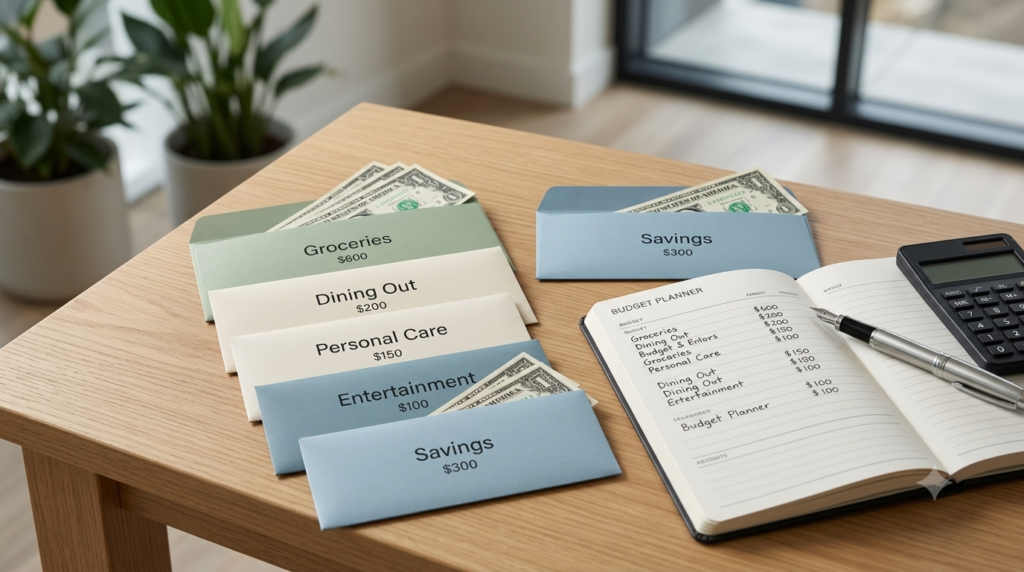
Zero-Based Budget Example
Consider someone with $4,000 in monthly take-home income.
Their goal is to create a zero-based budget where the full $4,000 is intentionally allocated.
| Budget Category | Planned Amount |
|---|---|
| Housing | $1,100 |
| Groceries | $450 |
| Transportation | $300 |
| Utilities and phone | $250 |
| Insurance | $200 |
| Debt payments | $400 |
| Emergency savings | $400 |
| Long-term savings | $300 |
| Personal spending | $200 |
| Entertainment | $150 |
| Irregular expenses fund | $150 |
| Miscellaneous | $100 |
| Total | $4,000 |
This example illustrates the principle rather than prescribing how everyone should spend their money. A good zero-based budget should reflect your actual income, expenses, financial obligations and goals.
Advantages of Zero-Based Budgeting
Zero-based budgeting can provide several benefits when it is used consistently.
- Greater awareness of where your money goes.
- More deliberate spending decisions.
- Clearer savings goals.
- Better visibility into debt payments.
- Greater control over discretionary spending.
- Better preparation for predictable irregular expenses.
The biggest advantage is often not simply spending less. It is knowing why your money is being allocated in a particular way.
Disadvantages of Zero-Based Budgeting
Zero-based budgeting is not perfect for everyone.
The method can require more attention than a very simple budgeting system because categories need to be reviewed and adjusted as your actual spending changes.
It can also become frustrating if your income or expenses change frequently and you expect every monthly plan to be exact.
Advantages
- Detailed financial visibility
- Clear spending priorities
- Useful for savings goals
- Can help identify waste
- Flexible category allocation
Potential Challenges
- Requires regular attention
- Can feel detailed at first
- Needs adjustment when circumstances change
- May be harder with unpredictable income
- Requires realistic estimates
Zero-Based Budgeting vs. 50/30/20 Budgeting
Zero-based budgeting and the 50/30/20 budgeting method are not necessarily competing systems. They simply approach budgeting from different perspectives.
Zero-Based Budget
Assigns available income to specific categories until planned income minus planned allocations equals zero.
50/30/20 Method
Uses broad guidelines that commonly divide income among needs, wants and savings or debt repayment.
Simple Percentage Budget
Uses predetermined percentages or targets to organize spending without necessarily assigning every unit of income to a detailed category.
The best budgeting method is usually the one you can understand, maintain and adapt to your actual financial situation.
How to Use Zero-Based Budgeting With Irregular Income
Zero-based budgeting can be more challenging when income changes significantly from one month to another.
Freelancers, contractors, business owners, seasonal workers and commission-based earners may not know their exact income in advance.
In these circumstances, a conservative income estimate can help.
For example, if your monthly income normally ranges from $2,500 to $4,000, building essential expenses around the highest possible income can create problems during lower-income months.
You may instead build your core budget around a more conservative figure and assign additional income when it actually arrives.
Depending on your situation, extra income could then be directed toward emergency savings, taxes, debt, future expenses or other financial priorities.
Common Zero-Based Budgeting Mistakes to Avoid
1. Forgetting irregular expenses
Annual and seasonal expenses can cause major problems when they are ignored. Include them in your monthly plan through dedicated savings categories when appropriate.
2. Underestimating everyday spending
A budget based on unrealistic grocery, transportation or personal spending estimates may fail repeatedly.
3. Treating the budget as permanent
Your budget should change when your income, household, bills, priorities or financial goals change.
4. Creating too many categories
Detailed budgeting can be useful, but excessive categories can make the system difficult to maintain. Start with meaningful categories and add detail when it provides useful information.
5. Leaving savings out of the plan
If savings is important to you, give it a defined place in your budget rather than hoping money remains at the end of the month.
6. Forgetting to compare planned and actual spending
A budget becomes more useful when you compare your plan with what actually happened.
How to Stick With a Zero-Based Budget
A successful budgeting system does not require perfection. It requires consistency and regular adjustment.
Review your budget before the month begins
Look at expected income, bills, upcoming expenses, savings goals and debt obligations before allocating the month's money.
Track spending during the month
Check your spending regularly rather than waiting until the end of the month to discover that a category was significantly overspent.
Adjust categories when necessary
If an unexpected expense occurs, you may need to move money from another category or reduce discretionary spending.
Review the budget at the end of the month
Compare planned amounts with actual spending. Use what you learn to create more realistic numbers for the following month.
Focus on progress rather than perfection
A budget is a financial planning tool. An unexpected expense or an overspent category does not mean the entire system has failed.
Who Should Use Zero-Based Budgeting?
Zero-based budgeting can be useful for people who want a detailed understanding of their cash flow and spending priorities.
It may be particularly helpful if you:
- Want more control over monthly spending.
- Are working toward specific savings goals.
- Want to accelerate debt repayment.
- Have many financial priorities competing for your income.
- Frequently wonder where your money went at the end of the month.
- Want to prepare for large future expenses.
However, you do not have to use zero-based budgeting simply because it is popular. A simpler budgeting system may be better if you find detailed category planning difficult to maintain.
What Should You Do If You Overspend in a Zero-Based Budget?
Overspending does not necessarily mean you need to abandon the budget.
First determine why the overspending happened.
Was the original amount unrealistic? Did an unexpected expense occur? Was the spending discretionary? Did another category come in below budget?
If one category is overspent while another has money remaining, you may be able to reallocate funds.
If the same category is consistently overspent, the problem may be that the original budget does not accurately reflect your real spending.
Can Zero-Based Budgeting Help You Save More Money?
It can, particularly when it helps you identify spending that does not align with your priorities.
However, zero-based budgeting does not automatically increase your income or reduce your expenses. Its value comes from creating greater awareness and making deliberate decisions about available money.
For example, if you discover that a significant amount of money is going toward discretionary spending, you can decide whether some of that money should instead support an emergency fund, debt repayment or another goal.
Is Zero-Based Budgeting Good for Beginners?
Yes, but beginners should avoid making the process unnecessarily complicated.
Start with a manageable number of categories:
- Housing
- Food
- Transportation
- Utilities
- Debt
- Savings
- Personal spending
- Other important expenses
Once you understand your spending patterns, you can introduce additional categories where more detail is useful.
How Often Should You Update a Zero-Based Budget?
Many people find it useful to create or update their main budget once each month and check their actual spending throughout the month.
You should also update your budget when a significant financial change occurs.
Examples include a change in income, a new recurring bill, a major debt payment, a move, a change in household circumstances or a new financial goal.
Frequently Asked Questions About Zero-Based Budgeting
What is zero-based budgeting in simple terms?
Zero-based budgeting is a method where you assign your expected income to expenses, savings, debt payments and other financial priorities until the total planned allocations equal your expected income.
Does zero-based budgeting mean I spend all my money?
No. Money can be assigned to savings, investments, future expenses, emergency funds or debt repayment. The goal is for every unit of income to have a planned purpose.
What is an example of zero-based budgeting?
If your monthly income is $3,000, you could allocate that income among housing, food, transportation, utilities, debt payments, savings and discretionary spending until your planned allocations total $3,000.
Is zero-based budgeting better than the 50/30/20 method?
Neither method is universally better. Zero-based budgeting is more detailed, while 50/30/20 uses broader spending guidelines. The better choice depends on your goals, financial situation and preferred level of detail.
Can I use zero-based budgeting if my income changes every month?
Yes. People with irregular income can use conservative income estimates and adjust the budget when actual income becomes known.
What should I include in a zero-based budget?
Common categories include housing, food, utilities, transportation, insurance, debt payments, savings, discretionary spending and funds for irregular or future expenses.
How do I start a zero-based budget?
Start by calculating your expected income, listing your expenses, adding savings and debt goals, and then assigning the remaining income to specific categories until the planned total equals your expected income.
What happens if my zero-based budget does not balance?
If planned expenses and allocations are higher than income, review flexible spending, savings allocations and other categories to determine what can realistically be adjusted. If income is higher than planned allocations, assign the remaining money to an appropriate financial priority.
Can zero-based budgeting help me get out of debt?
A zero-based budget can make debt payments a clearly defined part of your financial plan. Whether it helps you become debt free depends on factors such as your income, debt balances, interest rates, expenses and repayment strategy.
Do I need a budgeting app to use zero-based budgeting?
No. You can use a spreadsheet, notebook, budgeting application or another tracking system. The important part is assigning income to specific purposes and reviewing actual spending.
Final Thoughts: Is Zero-Based Budgeting Worth Trying?
Zero-based budgeting can be a powerful way to understand and organize your money because it requires you to make intentional decisions about your income. Instead of treating your bank balance as one large pool of spendable money, you create a plan for housing, food, transportation, savings, debt, future expenses and other priorities. The method does require regular attention, but it can become much easier once you establish realistic categories and a consistent routine. Start with a simple budget, compare your plan with your actual spending, make adjustments when necessary, and improve the system over time.
Provenzy provides general financial education and information. Financial circumstances differ from person to person, and financial products, interest rates, fees, tax rules, laws and consumer protections can vary by country and over time. This article is for educational purposes only and should not be considered personalized financial, tax, legal or investment advice.