Index Funds for Beginners: How They Work and How Investors Use Them
Learn what index funds are, how they work, why investors use them, what they cost, the risks to understand, and how beginners can evaluate index funds as part of a long-term investment strategy.
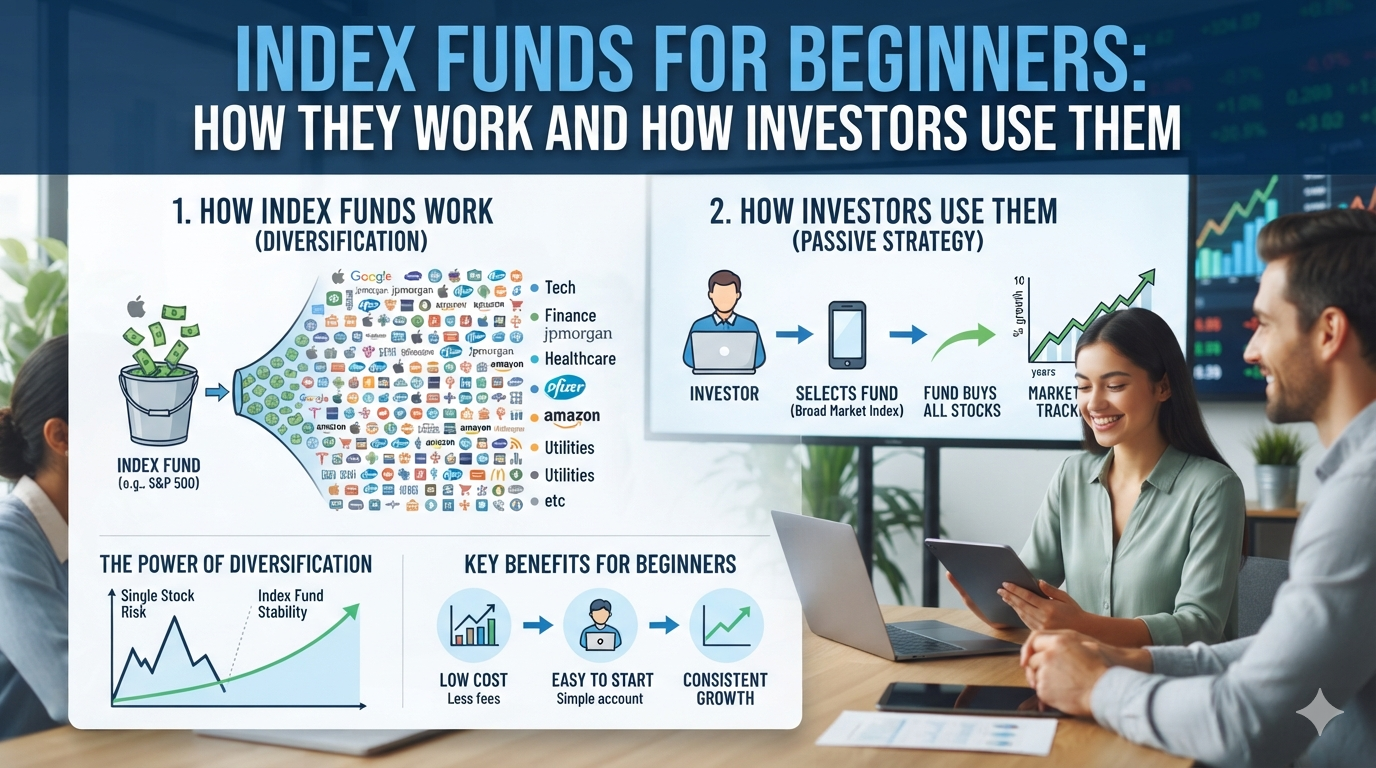
An index fund is an investment fund designed to track the performance of a particular market index. Instead of trying to select individual investments that will outperform the market, an index fund generally follows a defined group of securities. This approach can provide diversification, relatively low costs and a straightforward way to participate in long-term market growth, although index funds still carry investment risk and can lose value.
Investing can seem complicated when you first encounter terms such as stocks, bonds, mutual funds, exchange-traded funds, diversification, expense ratios and market indexes. One reason index funds have become such an important part of investing conversations is that they can simplify one of the biggest questions investors face: how do you build a diversified portfolio without having to research and select every individual investment yourself?
Index funds are designed around a relatively simple idea. Instead of asking a fund manager to decide which investments should be bought and sold in an attempt to beat a particular market, the fund attempts to track an index. The index might represent a broad stock market, companies of a particular size, a specific industry or a group of bonds.
That simplicity does not mean index funds are risk-free or automatically appropriate for every investor. Understanding how an index fund works, what it owns, what it costs, how closely it tracks its benchmark and how it fits into your overall financial plan is important before investing.
This guide explains index funds from the ground up, including how index funds work, the difference between index funds and actively managed funds, the benefits and limitations of index investing, common types of index funds, costs to watch, and practical considerations for beginners.
What Are Index Funds?
An index fund is a mutual fund or exchange-traded fund designed to track the performance of a specific market index. Rather than relying primarily on a manager's judgment to choose securities, the fund uses a rules-based approach intended to follow its chosen benchmark.
A market index is essentially a measurement of a particular collection of investments. An index might track a broad section of the stock market, a group of large companies, small companies, international stocks, government bonds or another segment of the investment market.
When you buy shares of an index fund, you are generally buying an interest in a portfolio that contains many investments represented by the fund's underlying index. You do not usually need to purchase each security separately.
An index fund is a pooled investment that seeks to follow the performance of a particular market index rather than trying to select investments specifically to outperform that index.
For example, imagine an index designed to represent a broad group of large publicly traded companies. An index fund tracking that index would generally hold investments intended to reflect the composition of that benchmark. As the underlying companies and their market values change, the fund's holdings and value can change as well.
This is one of the central ideas behind passive investing. Instead of attempting to predict which securities will outperform, the investor accepts the return of the selected market segment, minus the fund's expenses and the effects of tracking differences.
How Do Index Funds Work?
Index funds work by attempting to replicate the performance of a chosen benchmark. The exact method varies from one fund to another, but the basic process is relatively straightforward.
The fund selects an index to track
The investment fund identifies a specific benchmark. The benchmark establishes which securities belong in the index and how those securities are weighted.
The fund builds a portfolio
The fund purchases securities in a way intended to produce performance similar to the chosen index.
The index changes over time
When the underlying index changes its composition or weights, the fund may adjust its holdings to continue tracking the benchmark.
Investors experience market gains and losses
If the securities represented by the index rise in value, the fund can rise. If they fall, the fund can also lose value.
An important point for beginners is that an index fund does not guarantee the return of its index. The goal is to track the benchmark, but the fund's actual performance can differ slightly because of expenses, trading costs, taxes, portfolio construction and other factors.
Are Index Funds the Same as ETFs?
Not exactly. An index fund describes an investment strategy, while an ETF, or exchange-traded fund, describes a type of investment vehicle. An ETF can be an index fund, but not every ETF is an index fund.
Similarly, mutual funds can also be index funds. Some mutual funds attempt to track an index, while others are actively managed.
| Term | What It Describes | Can It Be Passive? |
|---|---|---|
| Index fund | A fund designed to track a market index. | Yes. The term generally refers to a passive strategy. |
| ETF | A fund structure that trades on an exchange. | Yes. Many ETFs track indexes, but some are actively managed. |
| Mutual fund | A pooled investment vehicle that can hold many securities. | Yes. Mutual funds can be index-based or actively managed. |
Index Funds vs. Actively Managed Funds
One of the most important distinctions in investing is the difference between passive and active management.
An index fund generally attempts to follow a benchmark. An actively managed fund generally gives a portfolio manager more discretion to select investments, change positions and attempt to outperform a benchmark or meet another investment objective.
Active management can involve more research, trading and portfolio decision-making. Those activities can contribute to higher costs, although costs vary considerably among individual funds.
Index investing takes a different approach. Rather than trying to identify which companies or securities will outperform, an index investor generally chooses a benchmark and accepts the performance of that market segment.
| Feature | Index Fund | Active Fund |
|---|---|---|
| Primary approach | Track a benchmark | Select investments based on manager decisions |
| Portfolio changes | Generally rules-based | Manager-directed |
| Goal | Match the benchmark as closely as practical | Often seek to outperform a benchmark |
| Costs | Often relatively low | Can be higher, depending on the fund |
| Research burden for investor | Often lower after choosing the fund | May require more evaluation of the manager and strategy |
Benefits of Index Funds for Beginners
Index funds have become popular because they combine several features that can be useful for long-term investors. Their benefits do not eliminate investment risk, but they can make portfolio construction more straightforward.
1. Diversification
Diversification means spreading investments across multiple securities rather than relying on one company or one asset. A broad index fund can provide exposure to many securities through a single investment.
This can reduce the impact that one company's poor performance has on the overall portfolio. However, diversification does not guarantee profits or prevent losses during a broad market decline.
2. Potentially lower costs
Many index funds have relatively low expense ratios because their investment strategy does not require the same level of ongoing security selection and trading as some actively managed funds.
Costs matter because investment expenses reduce the amount of money that remains invested. Even small differences in annual expenses can become meaningful over long periods.
3. Simplicity
For beginners, simplicity can be valuable. Instead of researching hundreds of individual companies, an investor can choose a fund that provides exposure to a particular market segment.
4. Broad market exposure
Some index funds provide exposure to large portions of a market. This can make them useful as core holdings within a diversified investment portfolio.
5. Transparent strategy
An index-based strategy is generally based on defined rules. Investors can examine the benchmark, fund objectives, holdings and expenses to understand what they are buying.
6. Useful for long-term investing
Index funds are frequently associated with long-term investing because they can provide broad market exposure without requiring an investor to constantly trade individual securities.
A long-term approach can also reduce the temptation to make frequent investment decisions based on short-term market movements.
Risks and Disadvantages of Index Funds
Index funds are not risk-free. One of the most important investing lessons for beginners is that diversification and low costs do not eliminate the possibility of losing money.
Potential Advantages
- Broad diversification
- Often relatively low costs
- Simple investment approach
- Rules-based strategy
- Potentially useful for long-term portfolios
Potential Limitations
- Market losses can reduce investment value
- Indexes can be concentrated in certain companies
- Funds can have fees and tracking differences
- Index funds cannot guarantee returns
- Some indexes are much narrower than others
Market risk
If the market or market segment represented by an index declines, an index fund tracking that market can decline as well. A broad stock market fund can lose substantial value during a major market downturn.
Concentration risk
Not every index is equally diversified. Some indexes may place significant weight on a relatively small number of companies or industries.
This means investors should look beyond the fund's name and examine what it actually owns.
Tracking differences
An index fund's return may differ from the return of its benchmark. This difference is sometimes referred to as tracking error or tracking difference, depending on the context.
No protection from market declines
Index investing is not a way to avoid market downturns. If the underlying market falls, the index fund is generally designed to participate in that decline.
How Much Do Index Funds Cost?
Costs are an important part of choosing an index fund. The most visible cost is often the expense ratio, which represents the fund's annual operating expenses as a percentage of assets.
For example, a fund with a hypothetical expense ratio of 0.10% would have annual operating expenses equivalent to about $1 per year for every $1,000 invested, before considering changes in the fund's value and other factors.
Investors should not choose a fund based only on the lowest expense ratio. The index being tracked, diversification, fund structure, liquidity, tracking quality and other characteristics can also matter.
Common costs to examine
- Expense ratio: The fund's annual operating expenses expressed as a percentage.
- Trading costs: Costs associated with buying or selling investments.
- Bid-ask spread: The difference between the price a buyer is willing to pay and the price a seller is willing to accept, particularly relevant when trading ETFs.
- Account costs: Fees charged by the brokerage or investment account, where applicable.
- Tax considerations: Taxes can affect the after-tax result depending on the account and investor's circumstances.
Types of Index Funds
There is no single type of index fund. Different funds track different sections of the investment market, so two index funds can have very different levels of diversification, risk and potential return.
Broad stock market index funds
Broad market funds seek to represent a large portion of a country's stock market. They can provide exposure to many companies across different industries and sizes.
Large-cap index funds
Large-cap index funds focus primarily on larger companies. They can be useful for investors who specifically want exposure to established businesses.
Small-cap index funds
Small-cap funds focus on smaller publicly traded companies. These companies can have different growth opportunities and risks compared with larger companies.
International index funds
International index funds provide exposure to companies outside an investor's home market. International investing can add geographic diversification but can also introduce currency, political and economic risks.
Bond index funds
Index funds do not have to invest in stocks. Bond index funds can track groups of government, corporate or other fixed-income securities.
Sector index funds
Sector funds concentrate on specific parts of the economy, such as technology, healthcare, energy or financial companies. Because they are more concentrated, they may carry greater sector-specific risk than broad market funds.
How to Choose an Index Fund
Choosing an index fund should begin with the investor's overall goal, not simply with whichever fund has recently produced the highest return.
Different investors have different time horizons, risk tolerances, financial goals and tax circumstances. A fund that makes sense as part of one person's portfolio may not be appropriate for another.
Identify the index
Find out exactly which benchmark the fund tracks. Do not rely solely on the fund's name.
Examine the holdings
Look at how many securities the fund owns and whether the fund is concentrated in particular companies, sectors or countries.
Compare expenses
Review the expense ratio and consider other potential costs associated with buying, selling and holding the investment.
Consider diversification
Determine whether the fund provides the type and amount of diversification you want.
Think about your time horizon
Consider when you may need the money. Investment choices should be consistent with your financial goals and ability to tolerate losses.
How Beginners Can Start Investing in Index Funds
Starting to invest does not necessarily require a complicated portfolio. However, beginners should first establish a solid financial foundation.
Before investing money needed for immediate expenses, consider creating a workable budget and building appropriate emergency savings. Our budgeting resources can help you understand how spending plans and financial priorities fit into the bigger picture.
It can also be useful to understand your existing debt. High-interest debt can have a significant financial cost, so investing should be considered alongside debt repayment and other financial priorities. Explore Provenzy's debt management guides for more information.
Step 1: Define your investment goal
Ask why you are investing. Your goal might be retirement, a long-term financial objective or another future expense. The purpose of the investment can influence your time horizon and asset allocation.
Step 2: Understand your risk tolerance
Stock index funds can experience significant price declines. Investors should understand how they might react emotionally and financially during a major market decline.
Step 3: Choose an investment account
Investors may use different types of accounts depending on their goals and circumstances. Retirement accounts and taxable brokerage accounts can have different tax rules and features.
If you are learning about retirement investing, you can continue with Provenzy's retirement planning resources .
Step 4: Research the fund
Review the fund's objective, benchmark, holdings, expenses, historical tracking performance and other available information before investing.
Step 5: Decide how much to invest
The amount you invest should fit your broader financial plan. Avoid investing money that you need for essential short-term expenses simply because markets have recently performed well.
Step 6: Stay focused on the long term
Long-term investing requires patience. Markets can rise and fall, sometimes sharply. Constantly changing an investment strategy because of short-term market movements can make it harder to follow a consistent plan.
Can You Invest in Index Funds With Small Amounts of Money?
In many cases, investors can begin with relatively small amounts, depending on the brokerage, fund and account they use. Some investment platforms allow fractional shares, while others have different minimum investment requirements.
One approach some investors use is investing a consistent amount at regular intervals. This is commonly known as dollar-cost averaging. Instead of attempting to predict the best time to invest, the investor invests according to a predetermined schedule.
Dollar-cost averaging does not guarantee a profit or protect against losses, and it is not necessarily superior to investing a lump sum in every situation. Its potential advantage is that it provides a structured process that can reduce the temptation to constantly time the market.
Common Index Fund Mistakes Beginners Should Avoid
Choosing a fund solely because its past return was high
Strong historical performance can be tempting, but past performance does not guarantee future results. Investors should understand what drove the previous performance and whether the fund still fits their goals.
Ignoring what the fund actually owns
The term "index fund" does not automatically mean broad diversification. Some index funds focus on narrow sectors, countries or investment characteristics.
Focusing only on expense ratios
Low costs matter, but the cheapest fund is not automatically the best fund for every investor. The benchmark, portfolio construction, liquidity, tracking quality and account availability should also be considered.
Selling because of a short-term market decline
Investors who choose a long-term strategy need to understand that market declines are possible. Selling during a downturn can turn an temporary decline into a permanent realized loss.
Building an unnecessarily complicated portfolio
Owning many funds does not automatically mean having better diversification. Different funds can hold many of the same companies, creating overlap that investors may not realize.
How Index Funds Fit Into a Diversified Portfolio
Diversification is about spreading exposure across investments that do not all behave in exactly the same way. A broad stock index fund may provide diversification across many companies, but investors may still need to consider other asset classes and geographic exposure depending on their individual strategy.
For example, someone who owns several different stock index funds may believe they have a highly diversified portfolio. However, if all of those funds hold many of the same large companies, the actual diversification may be lower than expected.
Portfolio diversification should therefore be evaluated based on the underlying holdings rather than simply counting the number of funds.
Using Index Funds for Retirement Investing
Index funds are commonly considered in retirement portfolios because retirement investing usually involves a long time horizon. A long investment horizon can allow investors to tolerate short-term volatility more effectively than someone saving for a goal that is only a few months away.
However, retirement portfolios should not automatically be invested entirely in stocks. The appropriate mix of stocks, bonds and other investments depends on factors such as age, income, financial goals, risk tolerance and the amount of time before withdrawals are expected.
Investors should also understand the tax rules associated with the specific retirement account they use rather than assuming every investment account works the same way.
Are Index Funds Good for Beginners?
Index funds can be a useful option for many beginners because they can provide diversification and a relatively simple way to gain exposure to a market. Their passive structure can also reduce the need for frequent investment decisions.
But "good" depends on the individual investor and the particular fund. A narrow sector index fund and a broad-market index fund may both be index funds while carrying very different levels of concentration and risk.
Beginners should therefore focus less on finding a universally "best" index fund and more on understanding what they are buying and why it fits their financial plan.
Key Takeaways About Index Funds
- Index funds are designed to track specific market indexes.
- They can provide exposure to many securities through one investment.
- Many index funds have relatively low operating expenses.
- Index funds can still lose money when the underlying market declines.
- Not every index fund is broadly diversified.
- Expense ratios are important, but they are not the only factor to evaluate.
- Investors should examine the benchmark and underlying holdings.
- A long-term strategy can help investors avoid making decisions based entirely on short-term market movements.
- The right investment approach depends on an individual's goals, time horizon, risk tolerance and financial circumstances.
Frequently Asked Questions About Index Funds
What is an index fund in simple terms?
An index fund is an investment fund designed to follow the performance of a particular market index. Instead of trying to select individual investments that will outperform the market, the fund generally follows a defined group of securities.
Are index funds safe?
Index funds are not risk-free. Their value can fall when the securities represented by their underlying index decline. Diversification can reduce certain risks but cannot eliminate investment losses.
Can index funds lose money?
Yes. An index fund can lose money when the investments it tracks decline in value. The amount of risk depends partly on the type of index the fund follows.
Are index funds good for beginners?
Index funds can be useful for beginners because many provide diversified market exposure through a relatively simple, rules-based strategy. However, investors should still understand the fund's holdings, costs, risks and investment objective.
What is the difference between an index fund and an ETF?
An index fund describes a strategy designed to track an index, while an ETF describes a fund structure that trades on an exchange. Many ETFs are index funds, but ETFs can also use active strategies.
How much money do I need to start investing in index funds?
The minimum can vary by fund and investment platform. Some platforms allow investors to buy fractional shares or make relatively small investments, while others may have minimum investment requirements.
Do index funds pay dividends?
Some index funds receive dividends from the securities they own. Depending on the fund and account, those distributions may be paid to investors or handled according to the fund's structure and the investor's selected options.
What should I look for when choosing an index fund?
Consider the index being tracked, diversification, expense ratio, holdings, tracking quality, fund structure, liquidity and how the investment fits your overall financial goals.
Build Your Investing Knowledge One Step at a Time
Understanding index funds is only one part of becoming a more informed investor. Continue exploring Provenzy's investing guides to learn about investment accounts, diversification, retirement planning and other important financial concepts.
Explore Investing Guides →